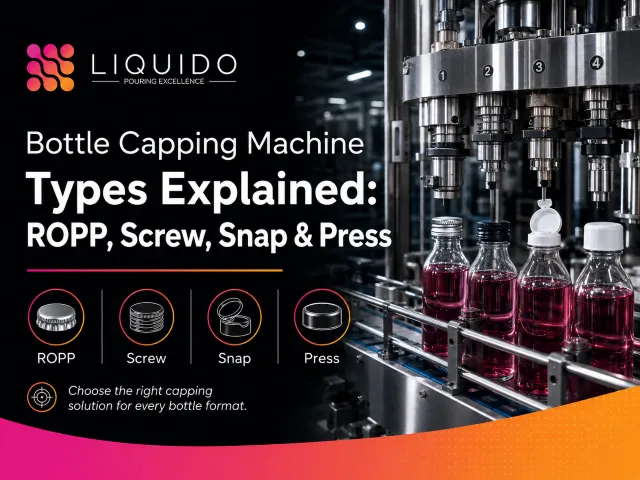
Bottle Capping Machine Types Explained: ROPP, Screw, Snap & Press
 By Liquido Engineering Team
Key Takeaways
- ROPP cappers form aluminium caps onto threaded necks - ideal for pharma, spirits, edible oil.
- Screw cappers apply controlled torque to pre-formed threaded caps - best for PET/HDPE.
- Snap-on / press cappers push non-threaded caps with controlled force - common in dairy and personal care.
- Match cap type, neck finish, and BPM target before picking head count.
- Torque control + cap orientation system are non-negotiable for repeatable seals.
Capping looks like the last step in a packaging line. In reality, it is the one step that decides whether your product reaches the customer intact. A bad cap fails tamper-evidence checks, lets oxygen and moisture in and turns a clean batch into a costly recall. Picking the right bottle capping machine means matching cap technology to container, throughput and seal-integrity standard - not just buying the most expensive head you can find.
This guide breaks down the four mainstream capping technologies in use across pharma, food, beverage, cosmetic and chemical lines, and explains where each one earns its keep.
What a Capping Machine Actually Does
A capper automates three coordinated motions: cap feeding (sorter bowl plus chute), cap placement (drop or pick-and-place) and cap closure (torque or vertical force). The closure mechanism defines the technology family. Get that wrong and no amount of speed will save the line.
ROPP Capping (Roll-On Pilfer-Proof)
ROPP machines take a flat aluminium blank cap and form it onto the bottle neck in real time using thread-forming and skirt-forming rollers. The result is a perfectly fitted, tamper-evident cap with a pilfer band that breaks on first opening.
Where ROPP wins
- Pharma syrups and tonics where tamper evidence is mandatory under CDSCO and USFDA norms.
- Spirits, liqueurs and premium beverages.
- Edible oils, ghee, vinegar and condiments.
Typical throughput
Single-head semi-automatic units handle 20-30 BPM. Inline 4/6/8-head automatic machines run 60-200 BPM. Rotary ROPP cappers exceed 400 BPM for high-volume beverage and pharma operations.
Screw Capping (Threaded Closures)
Screw cappers apply controlled torque to pre-threaded plastic or metal caps. The cap is fed open-side-down, dropped or picked onto the bottle, then rotated by a magnetic or servo torque head until the preset torque value is reached.
Where screw capping wins
- PET and HDPE bottles with moulded threads.
- Pharma plastic caps with integrated tamper bands.
- Cosmetics, juices, water, sauces and household chemicals.
Two torque-control approaches
- Magnetic clutch head - slips mechanically at the preset torque. Robust, low maintenance, ideal for stable SKUs.
- Servo torque head - electronic torque control with logged values for every cap. Required for validated pharma lines under 21 CFR Part 11.
Need a capper tuned to your bottle and cap?
Send us a sample. Our engineers will spec the right head, torque range and BPM - no obligation.
Get a Free Spec SheetSnap-On / Press-On Capping
Snap cappers apply controlled vertical force, not rotation. A non-threaded cap is pushed onto a retaining bead by a soft-touch press head until it clicks into place. The result is a fast, low-torque seal ideal for caps that don't need a thread.
Where snap capping wins
- Dairy bottles, milk jugs and dropper caps.
- Personal care - shampoo flip-tops, lotion press caps, sanitiser snap covers.
- Test-tube containers and small pharmaceutical vials.
Crown, Trigger & Pump Cappers
Specialised cappers handle closures that don't fit the mainstream categories:
- Crown cappers - carbonated beverages and beer with metal crown caps.
- Trigger sprayer cappers - household cleaners and automotive sprays with internal dip tubes.
- Pump cappers - lotion, sanitiser and serum pumps that require precise orientation before closure.
How to Choose the Right Capping Machine
Run through this short checklist before issuing a purchase order:
- Identify cap type - threaded metal, threaded plastic, snap-on, crown, pump or trigger.
- Confirm neck finish - GPI 28-410, ROPP 28 mm and so on.
- Calculate required BPM at peak demand plus a 15-20% margin.
- Establish compliance level - GMP, FDA, CE.
- Audit changeover frequency - how many cap formats per shift?
- Decide on integration - standalone unit or inline with filler and labeller.
The cap is the last line of defence on every bottle. Spend on the head, not just the frame.
Common Capping Issues - and Quick Fixes
- Cross-threading - check cap orientation in the sorter and chuck alignment with the bottle neck.
- Loose caps - increase torque setting; replace worn magnetic clutch springs.
- Cap damage - reduce torque or switch to softer polymer chuck inserts.
- Missed caps - inspect cap sorter bowl and feed chute for jams or wrong-orientation caps.
Why Choose Liquido for Capping
From semi-automatic single-head units to fully automatic multi-head lines, Liquido builds cappers tuned to your exact cap, bottle and torque spec. Every machine ships with on-site commissioning, validation documentation and operator training.
Conclusion
Capping technology should follow your closure - not the other way round. Profile your cap and bottle, set realistic torque targets, plan changeover, and pick the head that matches. Our engineers are one call away when you are ready.