How to Choose the Right Liquid Filling Machine for Your Production Line
 By Liquido Engineering Team
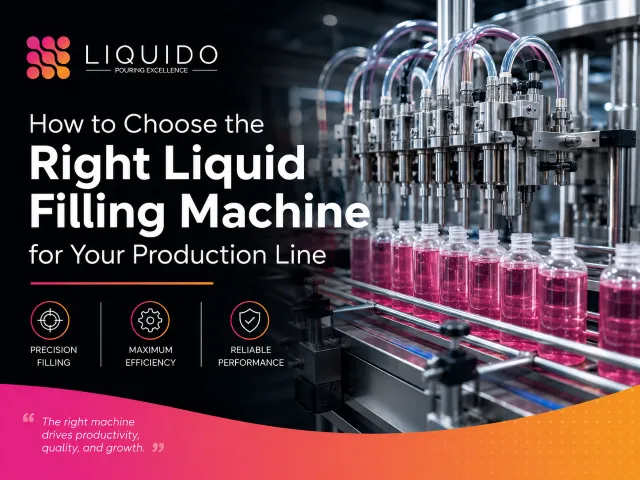
Key Takeaways
- Viscosity, fill volume, and container shape decide the filler technology.
- Match throughput (BPM) to your peak production demand plus a 15-20% safety margin.
- Servo-driven piston and flow-meter fillers offer the best accuracy and changeover flexibility.
- Always check material grade (SS 316L for pharma, SS 304 for food-safe).
- Total cost of ownership beats sticker price - factor in changeover, maintenance, and downtime.
Specifying the wrong filling machine is one of the most expensive mistakes a manufacturer can make. The capital outlay is only the first cost - the real losses come from years of slow throughput, high reject rates and operators fighting the machine on every shift. The good news: getting the spec right is a discipline, not a guess. Below is the framework our engineers use when sizing a liquid filling machine for pharma, food, cosmetic and chemical lines.
Start with the Product, Not the Machine
The liquid sets every other rule. Before evaluating a single vendor, build a hard product profile:
- Viscosity - measured in centipoise (cP). Water is 1 cP; honey is around 10,000 cP. The number drives nozzle design and pump choice.
- Foaming behaviour - agitation-sensitive products need anti-foam nozzles and bottom-up fill.
- Particulate content - solids, fibres or fruit pulp need large-bore valves and piston dosing.
- Temperature - hot fills above 70°C demand SS 316L and PTFE seals throughout the product path.
- Shear & oxidation sensitivity - pharma APIs, probiotic dairy and vitamin solutions need gentle handling and inert gas overlays.
Get this profile from QC, not from a brochure. Lab data beats assumptions every time.
Map the Full Container Range
List every container you fill today and every one you intend to fill in the next 24 months. Note minimum and maximum fill volume, neck diameter, container height and material. A line that has to span 50 mL vials to 5 L jerry cans will need very different change parts than one running a single 1 L SKU. Buy capability, not just the immediate need.
Watch out for: Container stability
Tall, narrow PET bottles tip on indexing conveyors. If your portfolio includes them, side guides and bottle-base support matter more than nozzle count.
Calculate Honest Throughput
The most common sizing mistake is buying to the brochure speed. Real throughput needs three numbers:
- Peak daily demand in units per day.
- Usable production hours per day - after breaks, CIP and changeover.
- A safety multiplier of 1.15-1.20 for small stops and quality holds.
That gives your required bottles per minute (BPM). Buy to it, not below it. A line sized exactly to demand has zero headroom for growth or unplanned downtime.
Most under-sized lines fail not because the machine is slow, but because nobody accounted for changeover, CIP and small stops. Plan the day, then pick the machine.
Pick the Right Filling Technology
Four mainstream technologies cover almost every application:
- Gravity fillers - simple and cheap, suited to thin free-flowing liquids where ±2% accuracy is acceptable.
- Piston fillers - volumetric, repeatable to ±0.5%, the right pick for thick liquids, creams, sauces and products with particulates.
- Flow-meter fillers - mass-flow or magnetic, top-tier accuracy on thin liquids with the easiest format changeover.
- Pressure / overflow fillers - level fill for clear bottles where every container must look identical on the shelf.
Not sure which technology fits your product?
Our engineers will spec a machine to your exact liquid, container and throughput - free of cost.
Get a Free ConsultationValidate Material Grade by Industry
Product-contact parts are not a place to economise:
- Pharma / injectables - SS 316L, electropolished to Ra ≤ 0.8 µm, FDA-grade elastomers.
- Food & beverage - SS 304 minimum, food-grade gaskets, CIP-ready geometry with no dead legs.
- Cosmetics - SS 304 or 316 depending on product chemistry and fragrance compatibility.
- Chemicals - confirm via compatibility chart; PTFE or Hastelloy may be required for aggressive solvents.
Plan for Changeover, Not Just Production
If you run multiple SKUs, changeover time becomes hidden capacity. Look for tool-less size-part swaps, recipe-based HMI recall and servo-driven format adjustment. A 15-minute changeover instead of a 90-minute one returns 4-5 hours of extra production every week - often more value than buying a faster machine.
Total Cost of Ownership Over Sticker Price
The cheapest machine is rarely the cheapest line. When comparing quotes, sum the 5-year cost of spare parts, energy consumption per 1,000 fills, operator skill required, average downtime per 1,000 hours, and service response time in your region. A 20% higher capital cost often saves 40% in total cost over the life of the line.
Why Choose Liquido Colossusfill?
We have been building filling, capping and labelling machinery since 2014 - tuned for Indian manufacturers and exported worldwide. Every machine ships with on-site commissioning, validation documentation, operator training and a service contract you can actually reach when a line goes down at 11 pm.
Conclusion
The right filling machine starts with the right questions. Profile your product, map your container range, calculate honest throughput, choose the technology that matches and build for the next five years - not the next quarter. When you are ready to talk specs, our engineers are one call away.