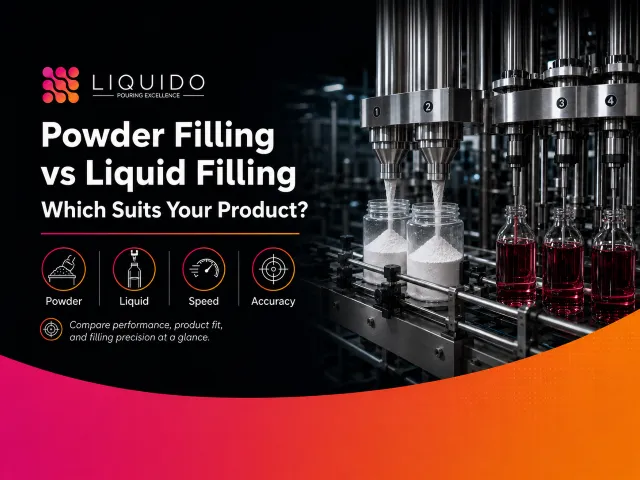
Powder Filling vs Liquid Filling: Which Suits Your Product?
 By Liquido Engineering Team
Key Takeaways
- Powder behaviour - free-flowing, sticky, hygroscopic, fibrous - dictates the dosing system.
- Auger fillers dominate powder applications; piston and flow-meter dominate liquid.
- Bulk density and angle of repose are the two numbers every powder buyer must know.
- Check-weighers in line tighten powder accuracy from +/- 2% to +/- 0.5%.
- Liquid vs powder is rarely interchangeable - pick the line for the dominant product type.
Whether you fill protein powder, ground spice, milk powder, shampoo or industrial coolant, the very first decision on a production line is technology family: powder filling or liquid filling. The two share almost nothing - dosing mechanism, accuracy class, hygiene protocols and even operator training differ completely. Choosing the right one is not a brand decision; it is a physics decision.
Profile the Product First
Before evaluating any vendor, build a hard product profile:
- Liquid: viscosity (in cP), foaming tendency, particulate content, fill temperature, shear sensitivity.
- Powder: bulk density (g/cm³), angle of repose, particle size distribution, hygroscopicity, fibre content.
These two number sets steer the entire machinery spec. Without them, every quotation you receive is a guess.
Liquid Filling Technologies at a Glance
Piston Filler
Volumetric dosing through a precision piston-and-cylinder. Highly accurate, handles thick liquids and particulates without crushing them. The right pick for sauces, creams, lotions, shampoos and viscous pharma products.
Flow Meter Filler
Electronic mass-flow or magnetic-flow measurement. Top-tier accuracy on thin, free-flowing liquids - juices, water, saline, ethanol. Excellent for multi-SKU lines because volume changeover is a recipe change, not a hardware swap.
Gravity Filler
Simple, low-cost, low-maintenance. Suits thin liquids where ±2% accuracy is acceptable - most water and edible-oil applications.
Pressure / Overflow Filler
Level fill - every bottle looks identically full to the eye. Used in clear-bottle beverages, perfumery and any application where shelf appearance drives sales.
Powder Filling Technologies at a Glance
Auger Filler
A rotating screw inside a hopper meters powder by revolution count. The auger filler is the dominant powder technology - it handles roughly 80% of powder applications, from spices to instant coffee to pharma APIs.
Volumetric Cup Filler
Adjustable cup chambers dose by volume. Cheap and reliable for free-flowing, uniform powders like sugar and salt. Lower accuracy than auger systems and not suitable for fine or fluffy products.
Net Weigher / Multi-Head Weigher
Combination scale heads weigh small fractions, then combine them to hit a target weight. Highest accuracy class. Common in snack, confectionery and dry-fruit packaging.
Filling powder or liquid? We build both.
Send your product spec and target throughput. Our engineers will recommend the dosing system that matches - at no cost.
Talk to an EngineerDecision Matrix: Which Filler When?
Pick Powder Filling When:
- The product is dry, granular or powdered.
- Dose tolerance is ±1% or wider.
- Containers are jars, sachets, cans or wide-neck bottles.
- The product is hygroscopic and needs a dust-controlled environment.
Pick Liquid Filling When:
- The product is pourable, from water-thin to thick paste.
- Dose tolerance is ±0.5% or tighter.
- Containers are bottles, vials or ampoules with narrow necks.
- The product requires CIP (clean-in-place) between batches.
Handling Difficult Powders
Not every powder behaves like sugar. The toughest customers:
- Sticky / fatty - chocolate powder, fat-coated milk powder. Need a heated hopper and a low-friction auger flight.
- Hygroscopic - lactose, citric acid. Need dust extraction, nitrogen flushing and fast cap-on downstream.
- Fibrous - psyllium husk, instant coffee. Need a large-pitch auger and an anti-bridging stirrer in the hopper.
- Light or fluffy - cocoa, talcum. Need vacuum-assist dosing and a gentle bowl agitator.
A free-flowing powder fills itself. A sticky one will out-engineer your machine if you spec wrong. Always send a 5 kg sample for trial before commissioning.
Hygiene & Compliance Differences
- Liquid lines: CIP and SIP cycles are standard. SS 316L mandatory for pharma. Surface finish Ra ≤ 0.8 µm.
- Powder lines: dust extraction systems, ATEX rating for combustible dusts (sugar, cornstarch, aluminium powder), wash-down or dry-clean protocols.
Cost Comparison at a Glance
Per-machine cost varies, but ballpark for similar throughput:
- Semi-automatic powder auger is roughly equal to a semi-automatic piston filler.
- Multi-head powder fillers run 15-25% higher than multi-head liquid fillers.
- Multi-head weighers are the highest cost class - reserved for premium snack and confectionery.
Why Choose Liquido
Liquido builds powder auger fillers, automatic liquid fillers, six-head flow-meter fillers and semi-automatic units. Whatever your product, the right machine is in our catalogue - or we will customise one to fit.
Conclusion
Powder and liquid filling are different worlds. Profile your product first, list your accuracy and hygiene needs second, then pick the dosing system designed for that physical state. Cross-purpose machines exist - but the dedicated one always wins on uptime and accuracy.