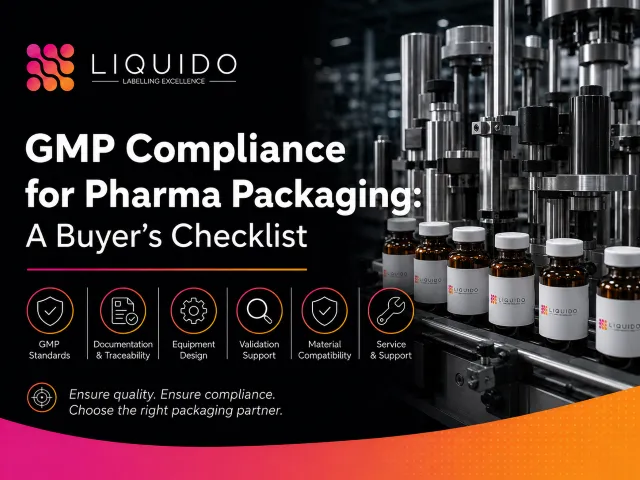
GMP Compliance for Pharma Packaging: A Buyer's Checklist
 By Liquido Engineering Team
Key Takeaways
- GMP compliance is non-negotiable for pharma packaging - design it in from day one.
- SS 316L contact parts, electropolished, surface finish Ra <= 0.8 um.
- 21 CFR Part 11: audit trails, user logins, tamper-evident logs for any electronic record.
- Validation documentation: IQ, OQ, PQ - request templates from the supplier upfront.
- Plan for cleaning, batch changeover, and operator training as core compliance pillars.
In pharmaceutical packaging, the machine itself is part of the regulatory dossier. An auditor from CDSCO, USFDA or EMA can pause your release schedule for a missing material certificate, an undocumented HMI parameter or a serial number you cannot trace. GMP compliance is therefore not a feature to bolt on after commissioning - it is the foundation you build the entire pharma filling line on.
This checklist covers the must-have requirements every pharma buyer should verify before issuing a purchase order.
What GMP Means for Packaging Machinery
GMP - Good Manufacturing Practice - is the system of regulations enforced by the FDA, EMA, WHO and India's CDSCO. For packaging machinery specifically, it covers six pillars:
- Materials of construction.
- Cleanability and CIP / SIP capability.
- Documentation and batch traceability.
- Operator access controls.
- Validation and qualification protocols.
- Change control on every parameter that can move.
Materials of Construction
Product-contact parts - SS 316L is mandatory. SS 304 is acceptable only for non-contact frames and external panels.
Surface finish - Ra ≤ 0.8 µm on all wetted surfaces. Electropolished finish preferred for sterile applications.
Gaskets and seals - FDA-grade silicone, EPDM or PTFE, with material certificates for every batch.
Documentation - 3.1 mill test certificates for every contact part, supplied as part of the validation pack.
Cleanability & Sanitisation
The machine must clean to validated standards between batches:
- CIP (Clean-In-Place): built-in spray balls, drain points and no dead legs in pipe runs.
- SIP (Sterilise-In-Place): ability to flush with hot water or pure steam at validated temperatures.
- Disassembly for clean: tool-less breakdown for parts that cannot be CIP-cleaned.
Ask your supplier for the cleaning validation protocol upfront. If they don't have one, walk away.
21 CFR Part 11 & Electronic Records
If the machine logs any electronic data - recipes, batch records or alarm logs - it falls under 21 CFR Part 11. The non-negotiable features:
- Unique user logins with role-based access control.
- Time-stamped audit trail of every parameter change.
- Tamper-evident records - no silent edits or deletes.
- Electronic signature workflow for batch release.
- Secure backup and long-term archival.
Building a pharma line?
Our engineers ship validation-ready machines with IQ / OQ templates, material certificates and 21 CFR Part 11 features pre-built.
Request Compliance PackValidation Documentation - IQ, OQ, PQ
IQ - Installation Qualification
Verifies the machine is installed exactly to specification. Covers utilities, calibration, drawings, manuals and material certificates.
OQ - Operational Qualification
Tests the machine across its operating range. Verifies sensors, alarms, interlocks and parameter accuracy at the high, low and target values.
PQ - Performance Qualification
Confirms the machine consistently produces output meeting quality requirements under normal production conditions. Typically three consecutive validation batches.
A serious supplier provides IQ / OQ / PQ templates as part of the standard delivery - not an extra-cost option.
Operator Safety & Access Controls
- Interlocked guards on all moving parts.
- Light curtains where reach is required during normal operation.
- Emergency stops within 0.6 m of every operator position.
- Role-based HMI access - operator, supervisor, admin and QA each with distinct permissions.
Traceability & Batch Records
Every batch must produce a complete electronic record:
- Start and end timestamps.
- Recipe parameters used during the run.
- Alarm and event log with operator acknowledgement.
- Reject counts with reason codes.
- Operator IDs for every action taken.
In a regulatory inspection, the auditor will ask three things: who, when and what. Your machine must answer all three from its own records - without operator memory.
Supplier Audit Checklist
Before purchase, audit the supplier on:
- ISO 9001 or equivalent quality system in place.
- In-house QA / QC and final inspection records.
- FAT (Factory Acceptance Testing) protocol available before dispatch.
- References from comparable pharma installations you can actually call.
- After-sales service network in your region with documented response SLAs.
Sterile & Aseptic Lines - Extra Requirements
For injectables and sterile liquids, additional requirements apply on top of standard GMP:
- Grade A laminar flow over the fill zone.
- Isolator or RABS (Restricted Access Barrier System) integration.
- Pre-sterilised contact parts or in-place sterilisation capability.
- Continuous environmental monitoring linked to the batch record.
Why Choose Liquido for Pharma Packaging
Liquido has commissioned GMP-compliant filling, capping and labelling lines for pharma manufacturers across India and abroad. Every pharma machine ships with material certificates, validation templates, 21 CFR Part 11 features and on-site validation support.
Conclusion
GMP is not a sticker; it is a foundation. Build the machine spec around compliance from day one, audit your supplier rigorously, and demand the full documentation pack at handover. Inspections become predictable when the line is built right.