 By Liquido Engineering Team
Key Takeaways
- Choosing the right bottle labelling machine ensures consistent label application and improved production efficiency.
- Understand bottle shape and size to select compatible labelling machinery from a reliable bottle labelling machine manufacturer in India.
- Consider label format and placement for accurate machinery configuration and optimal production workflow.
- Assess your production output needs to determine the appropriate level of automation for labelling equipment.
- Evaluate compatibility with existing packaging lines to avoid bottlenecks and maintain production flow.
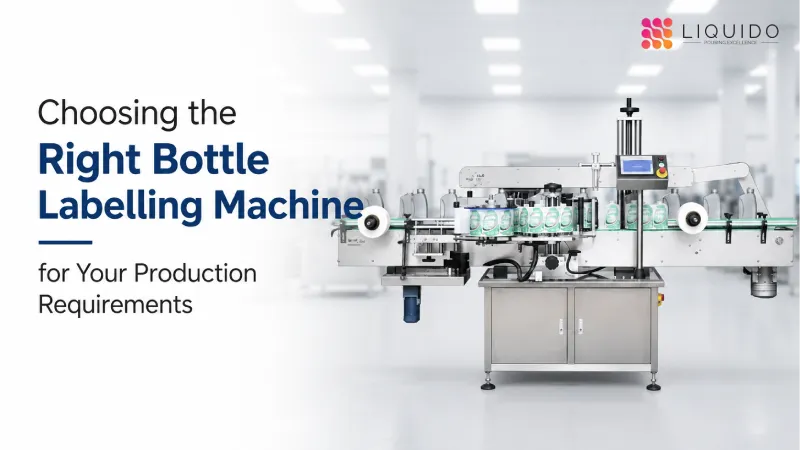
Liquido is a leading manufacturer of bottle labelling machines for organised and efficient packaging operations. A bottle may be filled correctly and capped properly, but poor label placement can still affect the final appearance of the packaged product. Crooked labels, wrinkles, inconsistent positioning, or slow manual application can quickly become a concern when production volumes start increasing.
Choosing the right bottle labelling machine is therefore not just about adding another piece of equipment to a packaging line. The machine needs to suit the bottle, label format, required application position, and actual production flow. Businesses searching for a Bottle Labelling Machine Manufacturer in India should first understand their packaging requirements clearly. The right selection can support smoother production, consistent label application, and a more organised packaging process.
Why Does the Right Bottle Labelling Machine Matter?
Labelling is one of the final visible stages of bottle packaging. The label may carry product information, branding, usage details, or other content relevant to the packaged product. Its application needs to match the intended bottle and label design.
Manual label application can be practical for very small quantities. As production increases, however, placing every label by hand becomes repetitive and time-consuming. Differences in operator handling may also affect label positioning.A bottle labelling machine introduces a defined process for label application. Depending on the equipment configuration, bottles can be positioned or moved through the labelling section while the machine applies labels according to the designed setup.
An experienced Bottle Labelling Machine Manufacturer should discuss the complete application rather than recommend machinery based only on general production speed.
Start with Your Bottle Shape and Size
The bottle itself is one of the first factors to consider. Round, flat, oval, and specially shaped containers may require different labelling arrangements.
A machine suitable for a standard round bottle may not automatically be the correct solution for a flat container. Bottle height, diameter, surface shape, and stability during movement can influence the labelling process.
Before selecting equipment, keep clear bottle details ready:
- Bottle shape and dimensions
- Material of the container
- Surface area available for labelling
- Position where the label needs to be applied
- Different bottle sizes used in production
It should be discussed at the outset if handling several bottle formats. Changeover requirements and machine suitability can then be evaluated according to the actual packaging process.
Liquido focuses on application details because bottle compatibility is an important part of practical machinery selection.
Understand the Type of Label You Use
The label format matters just as much as the bottle. Manufacturers should clearly identify how the label is supplied and where it needs to be placed.
For example, a production requirement may involve a single label, front and back labels, or wrap-around label application. The correct machinery configuration depends on the intended labelling pattern.
Label dimensions, roll specifications, and application position should be shared during machinery discussions. Providing accurate information can help the Bottle Labelling Machine Manufacturer in India understand the packaging requirement more clearly.
Do not select machinery simply because it is described as a “bottle labelling machine.” The actual label application is what determines whether the equipment matches your production needs.
Match the Machine with Your Production Output
Production output is another major consideration. A small batch-based packaging operation and a continuous high-volume production line have different requirements.
Ask yourself a few practical questions:
- How many bottles are handled during regular production?
- Is production continuous or batch-based?
- Is manual labelling currently slowing down the packaging process?
- Will production volume increase in the future?
- Does the labelling stage need to match an existing filling and capping line?
These questions can help identify the level of automation required.
A machine with unsuitable output capacity may create a bottleneck in the packaging line. However, the real manufacturing environment should also be taken into consideration when choosing equipment.The objective is to create a balanced process where labelling works efficiently with other packaging stages.
Manual, Semi Automatic, or Automatic Labelling?
The level of automation should match the production requirement. Not every manufacturer needs the same machinery setup.
Manual Labelling
Manual application may work for very limited quantities or specialised packaging. The process depends heavily on operator handling and can become slow as production increases.
Semi Automatic Labelling
Semi automatic machinery generally combines operator handling with machine-assisted label application. It can be considered for batch production and businesses moving away from fully manual labelling.
Automatic Labelling
Automatic machinery is designed for a more continuous packaging workflow. Bottles can move through the labelling process as part of an automated line, depending on the machine configuration.
A reliable Bottle Labelling Machine Manufacturer can discuss the suitable automation level after understanding bottle volume and existing production arrangements.
Consider Label Placement and Application Consistency
A label should be applied at the intended position on the bottle. It might be difficult to maintain consistent placement throughout a big production batch when application is done by hand.
Machine-assisted labelling creates a more structured application process. The equipment design dictates the order in which the bottle and label proceed.This can support consistent label positioning for compatible bottles and properly prepared labels. Machine setup, bottle presentation, and label specifications all remain important.
Manufacturers should clearly explain whether they need front labelling, back labelling, wrap-around application, or another suitable arrangement. These details influence machine configuration and application planning.
Check Compatibility with Your Existing Packaging Line
A labelling machine should not be considered in isolation when it is being added to an existing production line. The filling and capping stages may already operate at a defined speed.
If bottles reach the labelling section faster than they can be handled, accumulation may occur. If the labelling stage operates differently from the wider workflow, production coordination can become difficult.For this reason, businesses working with a Bottle Labelling Machine Manufacturer in India should share information about their current packaging equipment.
Important details may include:
- Existing filling machinery
- Capping equipment
- Conveyor arrangement
- Bottle movement direction
- Available installation space
- Downstream packaging operations
Liquido understands filling, capping, and labelling processes, allowing us to discuss machinery within the broader packaging workflow.
Think About Changeover Requirements
Many manufacturers use more than one bottle size or packaging format. If your production changes between bottles or labels, machine changeover requirements deserve attention.
Ask how the equipment will be adjusted when moving from one compatible bottle format to another. The exact process depends on machine design and the difference between packaging formats.
Production teams should also consider how frequently changeovers occur. A company handling one bottle format continuously may have different priorities from a business running several batches.Sharing the full range of bottle and label requirements with the Bottle Labelling Machine Manufacturer can support more accurate equipment discussions.
Operator Convenience Is Important
Machinery is used by people every working day. A labelling machine should fit practically into the production environment and operating process.
Operators may need to load labels, monitor bottle movement, make suitable adjustments, and observe the application process. Clear operating procedures and appropriate training can support daily machine use.
When evaluating equipment, consider the experience of the production team. Understand who will operate the machinery and how it will be incorporated into existing responsibilities.A machine should support the packaging workflow rather than create unnecessary complications for operators.
Look at the Complete Packaging Process
One common machinery selection mistake is focusing only on a single process stage. Filling, capping, and labelling are closely connected in bottle packaging.
Suppose the filling stage performs efficiently and the capping process maintains regular bottle movement. If labelling remains slow and heavily manual, finished bottles may begin to accumulate.The right labelling equipment can help create better coordination across these production stages.
This is why choosing a machine should involve reviewing the complete packaging process. Identify where bottles enter the labelling section, how they are handled, and where they move after label application.A Bottle Labelling Machine Manufacturer in India with an understanding of packaging machinery can help discuss these practical workflow considerations.
Industries That Use Bottle Labelling Machines
Bottle labelling equipment may be considered across different industries where products are packed in suitable containers and require label application.
General applications may include:
- Pharmaceutical packaging
- Food and beverage packaging
- Cosmetic and personal care products
- Chemical product packaging
- Lubricants
- Household product packaging
- Other compatible bottle packaging operations
The industry name alone does not determine the machine. Two businesses in the same industry may use completely different bottles and labels.Machine selection should always begin with actual packaging samples, specifications, and production requirements.
Want a free line audit?
Our engineers will benchmark your OEE and identify the top three efficiency gains - in writing, free of cost.
Request Line AuditTypical Errors to Avoid When Choosing a Labeling Device
Choosing equipment without complete application details can lead to unnecessary production challenges.
Avoid these common mistakes:
- Selecting a machine only by claimed speed
- Ignoring bottle shape and stability
- Not sharing actual label specifications
- Forgetting future production requirements
- Ignoring existing conveyor and packaging equipment
- Assuming one machine configuration suits every bottle
- Failing to discuss multiple bottle formats
A practical discussion with a Bottle Labelling Machine Manufacturer should cover both current and expected production requirements.Clear information at the machinery selection stage can make production planning more straightforward.
Why Choose Us
At Liquido, focuses on bottle labelling machinery based on real packaging applications and production requirements. We understand that bottle shapes, label formats, output needs, and existing packaging setups can differ between manufacturers. Our approach begins with understanding these practical details before discussing a suitable labelling solution. With our knowledge of filling, capping, and labelling processes, we can consider how the equipment fits into the broader packaging workflow. Liquido values clear technical communication, application-focused machine selection, and practical production planning. We aim to help businesses create smoother labelling operations while reducing repetitive manual work and supporting organised bottle packaging.
Conclusion
Choosing the right bottle labelling machine requires careful consideration of bottle shape, label type, application position, production output, automation level, and existing packaging equipment. A machine selected according to actual production needs can support consistent label application and a smoother workflow. Manufacturers should avoid choosing equipment based on speed alone and instead review the complete packaging process. Liquido focuses on understanding bottle and label applications before discussing suitable machinery. Whether a business is moving away from manual labelling or developing a more automated packaging line, the right labelling solution can support efficient production and better coordination between packaging stages.
Choose the right bottle labelling machine for your production requirements. Call +91 98000 05293 Or Email: info@liquidofill.com to discuss your packaging needs with Liquido.
Bottle Labelling Machine Labelling Equipment Automatic Labelling Machine Bottle Packaging Label Applicator Packaging Machinery Industrial Labelling Bottle Label Application Packaging Automation Labelling Machine Manufacturer